How might we increase adoption of a restorative legal reform program?
Service blueprinting for a criminal justice reform model now operating in 60+ jurisdictions.
with FOR THE PEOPLE, 2023
ROLE
Project Lead, Researcher & Strategist
METHODS
In-depth interviews, Focus Groups, Field Observation, Convening, Ecosystem Analysis, Journey Mapping, Service Blueprinting, Archetype Development, Synthesis, Executive Storytelling & Report Design
DELIVERABLES
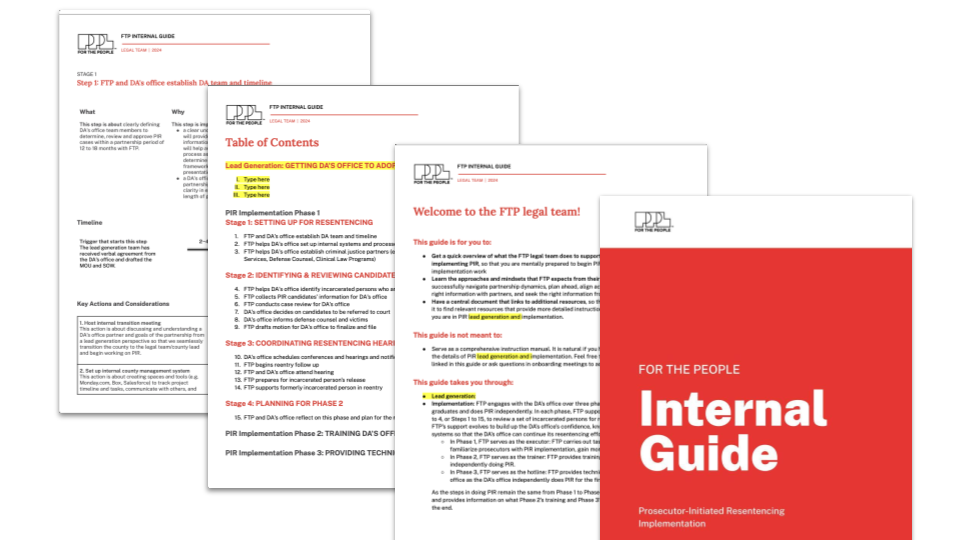
Strategic Insights Report, Service Blueprint, Journey Maps, Messaging Frameworks, Internal Operating Guide, Convening Design
01
THE CHALLENGE
For The People had proven their program works for years — but it lived in people's heads.
Prosecutor-Initiated Resentencing (PIR) lets prosecutors voluntarily revisit excessive sentences and recommend release. For The People had proven it worked in California for years.
But the program lived entirely in people's heads: no documentation, no repeatable training, no scalable playbook, and no clear answer to why some district attorneys embraced PIR while others declined. It couldn't scale on charisma alone.
02
MY ROLE
I led the project, and my first act was to change its shape
I owned the engagement end to end. I was responsible for:
-
Reframing the research brief from only studying one stakeholder group to full-ecosystem research, and getting client buy-in for the wider scope
-
Designing the research and sampling deliberately for range across DA types, champions and skeptics, and geographies
-
Recruiting and interviewing 66+ prosecutors, defense attorneys, and formerly incarcerated individuals
-
Conducting field observation at a DA convening inside San Quentin
-
Designing and facilitating a 1.5-day in-person design session with prosecutors and defense attorneys
-
Owning synthesis, turning it into journey maps, archetypes, and a service blueprint
-
Building the internal operating guide that made an undocumented program repeatable
-
Developing the messaging framework that reshaped how the organization approaches new jurisdictions
03
WHAT I DID
Reframed the brief to hold every stakeholder at once
The brief I was handed was narrow: study prosecutors so the client could recruit more of them. I pushed back and led the reframing, then owned the research design, fieldwork, synthesis, and the artifacts that turned it into an operating model.
04
THE PROCESS
Interviews across the ecosystem, then a hands-on design session
The research ran in two phases: in-depth interviews across the full justice ecosystem plus field observation inside San Quentin, then a 1.5-day design session with current and former prosecutors and defense attorneys, working through what makes PIR compelling to champions and what holds skeptics back.
Phase 1:
Stakeholder Research
Phase 2:
Ideation Sessions
In-depth interviews across the justice ecosystem
A 1.5-day session with 8 current and former prosecutors and 2 current and former defense attorneys


05
THE FINDINGS
One process, two completely different journeys
one.
One process, two different realities.
Prosecutors and incarcerated people move through the same PIR steps experiencing entirely different journeys. Side by side, the gap is impossible to ignore.
two.
Adoption is psychological, not procedural.
Whether a prosecutor championed or resisted PIR came down to openness to redemption, personal ties to the defense side, and experience.
three.
The bottleneck was knowledge, not will.
The program's dependence on a few people's undocumented expertise was what kept it from scaling.
06
WHAT WE DESIGNED