Why are babies dying and what would it take to change that?
Maternal health ecosystem research that became a 5-year strategic plan.
with CRADLE CINCINNATI, 2022-24
Lead Researcher & Strategist
ROLE
In-depth interviews, Focus Groups, Video Diaries, Surveys, Synthesis, Executive Storytelling & Report Design, Workshop Facilitation, Stakeholder Alignment
METHODS
DELIVERABLES
Insights Report, 5-Year Strategic Plan, Journey Map, Program Logic Models, Evaluation Framework, Staff Convening
01
THE CHALLENGE
Black families in Hamilton County lose infants at roughly three times the rate of white families, regardless of income or education.
Black infant mortality in Hamilton County, Ohio was running at 8.7 per 1,000 births. Cradle Cincinnati was running a portfolio of maternal health programs with clear strategic direction and no shared evidence base for which ones were working.
They came to us asking three questions:
- Are we missing what mothers actually need?
- Are our programs having the impact they should?
- Where are the real gaps and opportunities?
02
MY ROLE
I led two years of research, planning, and evaluation.
My project team consisted of 3 people. We synthesized this work into a five-year strategy and a set of program logic models, and built the evaluation framework the team still uses.
I was responsible for:
-
Designing and owning the full research plan
-
Leading participant recruitment across a hard-to-reach population
-
Developing guides and protocols for interviews and focus groups
-
Facilitating interviews, focus groups and co-design sessions
-
Owning synthesis - turning stories into actionable high leverage points
-
Building the program logic models and evaluation framework from scratch
-
Facilitating workshops that brought staff, leadership and funders to a shared diagnosis
-
Creating executive-ready design deliverables
-
Managing the client relationship through 2+ years of biweekly meetings
03
WHAT I DID
I designed a mixed-methods ecosystem study across 8 stakeholder groups.
I engaged with roughly 240 individuals including mothers, community health workers, clinicians, hospital administrators, county public health staff, funders, program partners, and Cradle's own staff and board members.
Methods:
-
In-depth Interviews and focus groups
-
Video diaries for time-pressed participants
-
Community ideation sessions
-
Survey validation
-
Logic models and program evaluation
I used different methods for different groups on purpose. Structured interviews for executives and funders who were short on time. Semi-structured interviews, intercepts, focus groups and video diaries for mothers and community health workers. Surveys for the larger community who was harder to reach in-person.

The hard part: Finding the right people
The mothers whose experience mattered most, those who had lost a child, were the hardest to reach; standard recruiting skews toward whoever is easiest to find. So, I recruited through community health workers and doulas who had already built trust in the community, and kept formats flexible so participation didn't add friction to an already difficult experience. I also met people where thy were at - community centers, libraries, churches.
04
THE PROCESS
From listening to prioritization to evaluation.
Stakeholder Research
Ideation Sessions
Strategic Planning
Understand the ecosystem from multiple perspectives.
Bring findings back into the room and co-generate solutions.
Translate stakeholder voices into a 5-year plan Cradle could act on.
Program Evaluation
Test whether existing programs aligned with what the research revealed.

05
THE FINDINGS
Three findings reshaped how Cradle understood the problem.
one.
Mental Health & Social Support
Mothers were isolated with no support system built for their reality
two.
Motherhood Readiness
Critical gaps in resources and life-outcome support before and during pregnancy.
three.
Doctor-Patient Trust
A communication and trust breakdown between providers and patients was actively working against care.
06
WHAT WE DESIGNED
I built artifacts that helped leaders see the system and act on it.

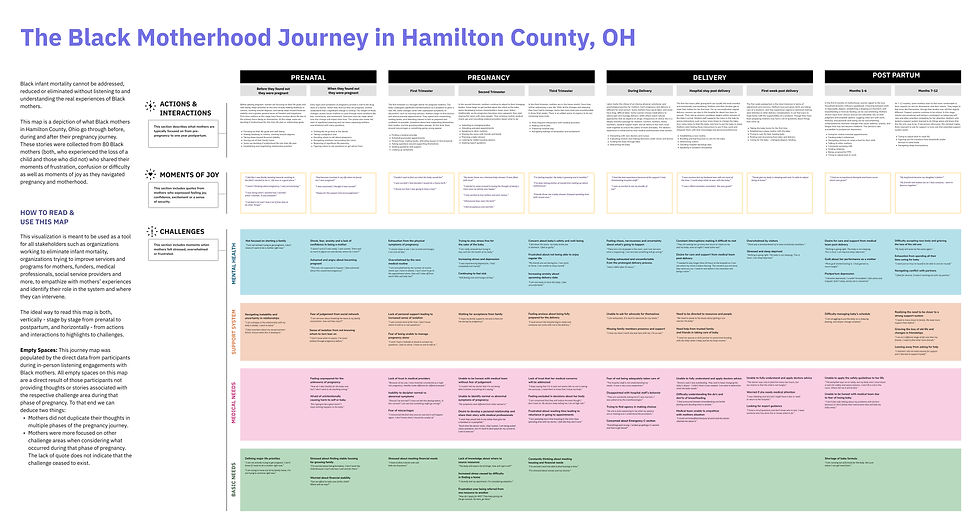
Pregnancy Journey Map
A decision and empathy tool that illustrates mothers' experiences navigating pregnancy and motherhood.
5-Year Strategic Plan
Defining the places in the system where focused effort would produce the most meaningful change in outcomes.
![[Internal] CC Phase 2 Research_2025-11-04_01-48-57.png](https://static.wixstatic.com/media/f19e6a_0cf93ee740be450e86a71a66b01cac90~mv2.png/v1/fill/w_980,h_630,al_c,q_90,usm_0.66_1.00_0.01,enc_avif,quality_auto/%5BInternal%5D%20CC%20Phase%202%20Research_2025-11-04_01-48-57.png)
Personas
Composites of the stories we heard- useful for communication with staff and funders

Program Logic Models
Documenting and visualizing the intended pathway from program activities > desired outcomes > impact on the ultimate goal.

Evaluation Framework
A structured monitoring and impact evaluation framework along with programmatic workbooks for the cradle team to independently iterate.

07
THE IMPACT
What changed for the organization -
-
Cradle adopted the five-year strategy, launched it publicly in 2023, and it remains the organization's operating strategy for 2023-2027.
-
Three programs were formally evaluated against the plan using the logic models — surfacing gaps, redundancies, and opportunities for programs to support each other instead of operating in silos.
-
The research led the organization to sunset two programs that didn't align with what we learned and to concentrate resources on the ones that did.
-
After the all-staff convening, 80% of staff reported a clearer connection between their work and the organization's goals.
-
The framing that came out of the research, mental health as a root cause, informal support as infrastructure, basic needs and medical trust as determinants, is now central to how Cradle publicly explains infant mortality and makes its case to funders.
-
Engagement grew 3x in scope over two years (research → strategy → evaluation), closing at 100% client satisfaction
-
During the engagement, county infant mortality reached 5.5 per 1,000 births, its lowest in at least 25 years and below the national average for the first time on record. Rates have since risen sharply, driven by extreme preterm birth, a reminder that the structural drivers this research identified are exactly the ground where the work continues.
05
WHAT I DESIGNED
I built artifacts that helped leaders see the system and act on it.
Pregnancy Journey Map
A decision and empathy tool that illustrates mothers' experiences navigating pregnancy and motherhood.
Five-Year Strategic Plan
Defining the places in the system where focused effort would produce the most meaningful change in outcomes.
Program Logic Models
Documenting and visualizing the intended pathway from program activities > desired outcomes > impact on the ultimate goal.

Evaluation Framework
A structured monitoring and evaluation framework along with programmatic workbooks for the cradle team to independently iterate.