How do you keep a neighborhood from being erased?
Strategic planning for a five-organization anti-displacement coalition in East San Jose
with SI SE PUEDE COLLECTIVE, 2025-2026
ROLE
Lead Researcher & Strategist
METHODS
In-depth interviews, Focus Groups, Intercepts, Synthesis, Stakeholder Mapping, Co-design Workshops, Executive Storytelling & Report Design, Workshop Facilitation, Stakeholder Alignment
DELIVERABLES
Visioning Session, Ecosystem Research, Organizational Analysis, 5-Year Strategic Plan, Strategic Plan Implementation Roadmap
01
THE CHALLENGE
Five organizations, one neighborhood, and no shared plan.
¡Sí Se Puede! is a coalition of five community-rooted nonprofits serving Mayfair, a historic immigrant neighborhood in East San Jose facing mounting displacement pressure. Between them they had deep trust, strong programs, and decades of credibility. What they didn't have was a shared plan.
Five organizations meant five sets of priorities, five working styles and five theories about what the neighborhood needed most. They needed one strategy for the next five years, and no single organization's view could be allowed to dominate it.
Their questions:
-
What do residents actually experience as the biggest displacement pressures, and what support do they trust?
-
What should SSPC focus on over five years?
-
What should five organizations build together, and how should we coordinate resources to prevent displacement and protect our neighborhood?
02
MY ROLE
I led nine months of research and strategic planning.
I owned the engagement end-to-end with my team of 2. We designed the research, led synthesis, facilitated the executive alignment among the 5 organizations and built the strategic plan.
I was responsible for:
-
Designing and owning the full research plan
-
Leading participant recruitment across a hard-to-reach population
-
Developing guides and protocols for interviews and focus groups
-
Facilitating interviews, focus groups and co-design sessions
-
Owning synthesis - turning stories into actionable high leverage points
-
Building the program logic models and evaluation framework from scratch
-
Facilitating workshops that brought staff, leadership and funders to a shared diagnosis
-
Creating executive-ready design deliverables
-
Managing the client relationship through 2+ years of biweekly meetings
03
WHAT I DID
Three layers of evidence on where to focus.
I ran in-person community engagement in Mayfair.
The approach had to give five organizations one plan without flattening their differences, so I built the research in three layers, because no single one could force a hard tradeoff alone.
-
Community research showed what residents actually experienced.
-
Organizational research showed where the five nonprofits' strengths overlapped and where they collided.
-
Systems analysis connected both to the forces driving displacement.
Only with all three on the table could the coalition see that no single-organization strategy could address a problem this distributed. I sequenced the work to start from vision before evidence, so alignment began from shared purpose rather than competing programs.
04
THE PROCESS
From a shared vision, through evidence, to a sequenced plan.
Visioning Session
Listening to the People
Co-creation Sessions
Built a shared vision: What does thriving in Mayfair look and feel like?
Learned about the current realities through Interviews, focus groups, site visits, surveys.
Synthesized insights into clear priorities and hosted cross-sector ideation sessions to generate solutions.
Strategic Planning
Developed a 5-yr strategic plan for the collective including pillars, objectives, strategies and metrics.



05
THE FINDINGS
Displacement was bigger than housing, and the coalition had gaps of its own
one.
Displacement is not just a housing problem.
Families were being pushed out by unstable income, immigration fear, healthcare gaps, youth opportunity, and cultural erasure at once.
two.
Culture and belonging are anti-displacement infrastructure.
Residents defined thriving as staying rooted and keeping their culture visible, not just economic stability.
three.
Stability is the ground everything else stands on.
Many residents lived one disruption away from collapse.
four.
The coalition had the ingredients but not the connective tissue.
Five organizations with programs and trust, but no shared systems to operate as one.
06
WHAT WE DESIGNED
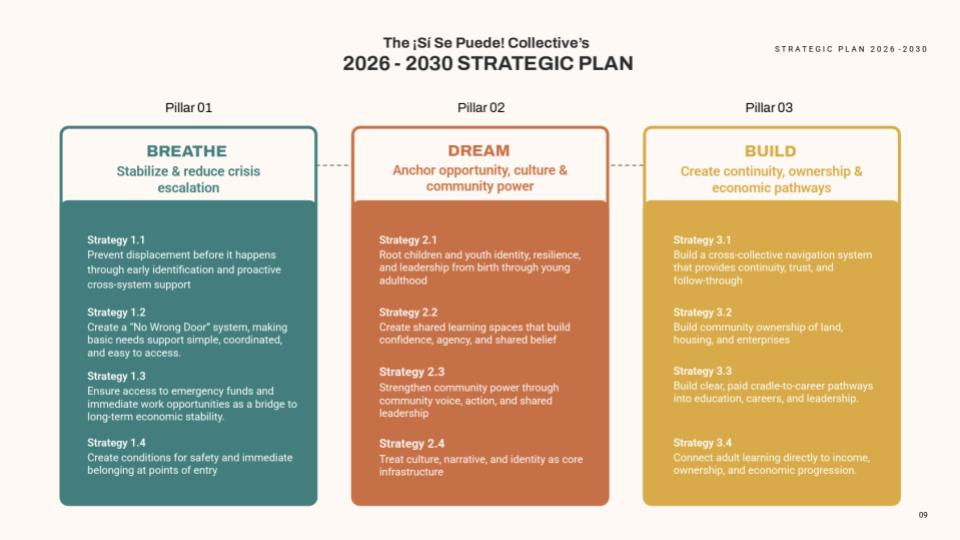
A five-year strategic plan built as a decision system - designed for residents, executives, funders and SSPC staff.
-
A 2026–2030 strategic plan organized around three pillars: Breathe, Dream, and Build
-
12 strategies with defined lane leadership across the five organizations
-
Shared language for displacement, resilience, and permanence
-
A governance and operating model for a 230-person coalition
-
A phased implementation roadmap clarifying near-term actions, roles, and investment needs

07
THE IMPACT
Five organizations, one adopted strategy, and a shift in how they think
-
All five organizations aligned on a shared direction and adopted the plan.
-
The engagement moved the coalition from "what programs should each of us run?" to "what system must we build together?"
-
The executive directors who arrived with competing agendas left aligned on displacement as the central threat, with a sequenced roadmap and the governance model to hold them to it.
08
REFLECTIONS AND TESTIMONIALS
What I learned
The research was the easy part; the room was the work.
Shared commitment to the community got five independent organizations to the table, but it took structured facilitation, evidence they could each see themselves in, and explicit tradeoff decisions to get them to move as one. Old tensions and organizational ego are what block the listening real collaboration requires, and structure is what gets past them.